
WVRJ Release Destinations
Western Virginia Regional Jail serves Roanoke, Franklin, and Montgomery Counties and the City of Salem. A Roanoke County prisoner housed there may leave for the community, return to a member jurisdiction, transfer to VADOC, move under USMS authority, or enter ICE custody. The regional roster alone cannot distinguish those paths after a result disappears.
The release or transfer entry is the key record. It should be tied to the correct commitment and, when releasable, identify the disposition or receiving agency. A court order can explain the legal basis for release but does not prove the physical handoff. VINE can preserve a timely event notice, yet it is not a long-term archive. When the destination is not public, WVRJ's Intake line or a focused records request supplies the best next step.
Check WVRJ Custody First
The official WVRJ search page describes its tool narrowly: it determines whether someone is incarcerated at the regional jail. The linked JailTracker roster is configured to show current offenders only. Use it to establish present public-list status, not to certify a past release.
- Search the exact name and compare available identifiers.
- Confirm that the result names Western Virginia Regional Jail.
- If a current match appears, treat it as current public custody evidence.
- If no match appears, call WVRJ and ask about release or transfer.
- Request the commitment, disposition, and release entries for historical proof.
- Check VADOC, BOP, ICE, or the federal docket when the next agency is unclear.
WVRJ software contains a 400-day released-retention setting, but the live display setting is current-only. Retention inside a system is not the same as public online access. Do not present the hidden value as a released-person archive. The Roanoke County released-inmate search paths explain how to continue across the other custodians.
WVRJ Records and Contact
WVRJ publishes distinct lines for its main office, Intake, the on-duty platoon commander, and Inmate Accounting. Intake is the most direct published contact for a recent commitment or movement. Inmate Accounting may help route a record tied to an individual. Hours for these specific lines are not stated in the research, so confirm before traveling.
5885 W. River Road
Salem, VA 24153
Main: 540-378-3700
Intake: 540-378-3770
Platoon commander: 540-378-3769
Inmate Accounting: 540-378-3723
Give the full name, date of birth if known, approximate commitment range, commitment or booking number, and Roanoke County as the committing member. That last detail matters because WVRJ serves four localities and houses other contract populations. Ask whether the event was a community release, member-jurisdiction movement, or transfer to another custodian.
The official WVRJ explanation below links users to the current incarceration check.
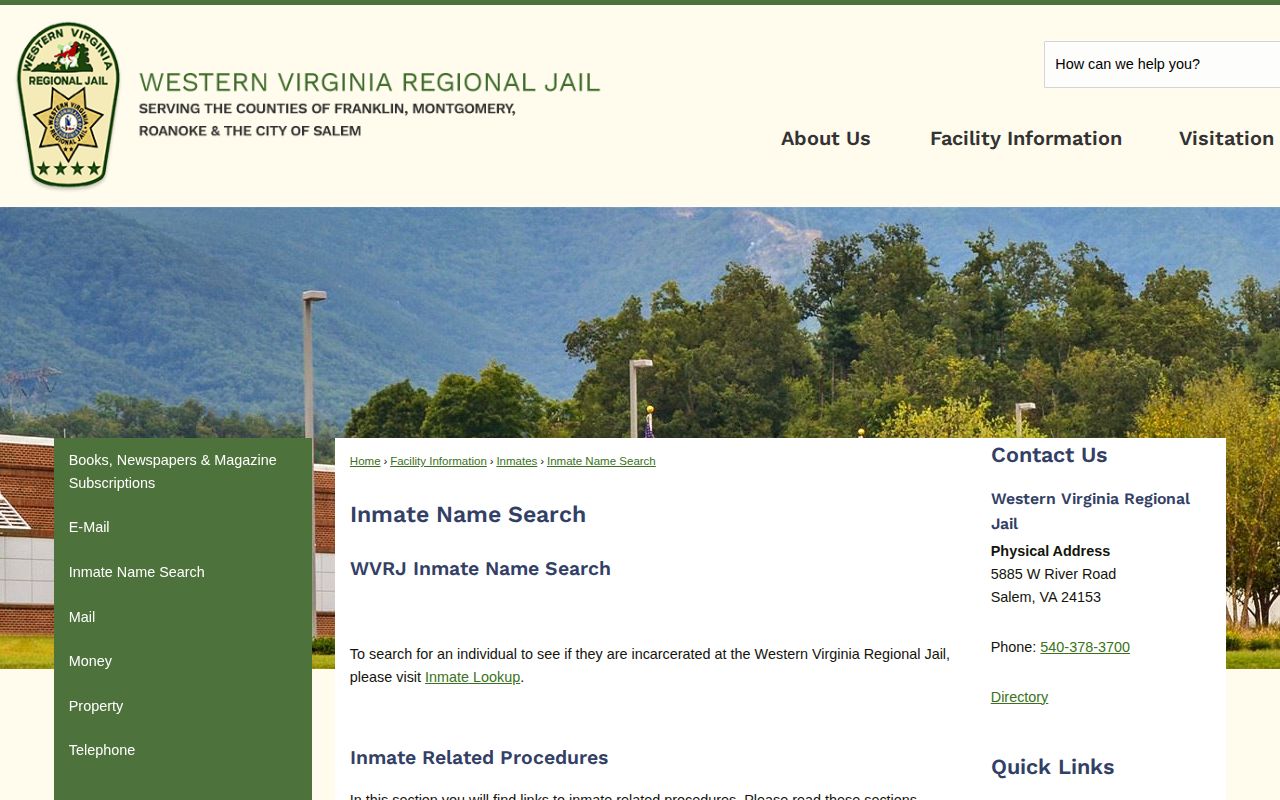
Its wording reinforces that the public tool answers present incarceration, while a historical release requires another channel.
Request a WVRJ Release Record
The WVRJ FOIA page identifies the authority's FOIA Officer and the same River Road address. Requests can be sent with enough detail to locate an existing record. Ask for the specific commitment, actual release date and time, disposition or transfer destination to the extent releasable, release authorization, and property-return acknowledgment.
A concise request avoids asking the jail to create a new report. Include the approximate date range and member jurisdiction. Ask for electronic copies, a cost estimate, and notice before costs exceed a stated limit. If part of a record is exempt, request the nonexempt, segregable portion and the legal basis for any withholding. WVRJ's published fax for FOIA is 540-380-3143, and its main number is 540-378-3700.
Virginia FOIA does not turn every imprisonment record into a mandatory disclosure. Privacy, security, investigative, sealed, and expunged-record rules may restrict production. Even so, the request route is essential because the public WVRJ interface does not offer a verified historical released view. A current roster screenshot is not a substitute for the custodian's dated disposition.
Note: Specify Roanoke County as the committing member so the regional authority can isolate the right commitment record.
WVRJ Release Property Proof
WVRJ's 2025 Annual Report describes a concrete property workflow. Property is inventoried and placed in an assigned tub. At release, the Property Officer changes the person out, returns the stored property, documents the handoff, obtains a signature, and scans the paperwork into Laserfiche. Donated clothing is available when suitable release clothing is needed.
The signed property acknowledgment can corroborate that a release workflow occurred. It may also help distinguish an actual handoff from a mere scheduled date. Request it by name, commitment number, and date, subject to disclosure rules. The report does not state the public exit, release time of day, weekend practice, waiting area, transit link, or rideshare policy. Those details cannot be inferred from the property description.
| Record | What it may establish |
|---|---|
| Commitment entry | When and under whose authority WVRJ received the person. |
| Release disposition | How that commitment ended and any recorded destination. |
| Property acknowledgment | A signed return of inventoried property during release processing. |
| Court order | The legal basis, not necessarily the exact physical handoff. |
| VINE notice | A contemporaneous reported event, not a permanent archive. |
WVRJ Release Volume Context
The regional jail's Fiscal Year 2024–25 Property operation processed about 3,515 intakes and 3,493 releases. Those figures measure facility workflows across member and contract populations. They are not counts of unique people, Roanoke County cases, or community releases. One person may account for more than one event, and a transfer can count as a release from WVRJ while custody continues elsewhere.
A historical Fiscal Year 2019 report recorded 4,698 committals and 4,642 releases, but those totals should not be treated as a direct trend without matching definitions. The safer use is operational context: WVRJ processes substantial movement across several custody types, which makes exact commitment numbers and destination records valuable.
WVRJ History Shapes Releases
WVRJ opened in 2009 after severe crowding in the older local facilities. It is a roughly 1,000-bed jail built for Roanoke, Franklin, and Montgomery Counties and Salem. Its official operations material also says it houses state-responsible, federal, and contract prisoners. This mixed role is the distinctive reason a vanished roster result is unusually ambiguous.
The site sits near Interstate 81 Exit 132, about ten miles south of downtown Salem. That location should not be turned into an unsupported transportation claim. No official release pickup point or transport service was verified. The annual report does document a Re-Entry Program, resource-fair work, DMV Connect, and requests for birth certificates and Social Security cards. These are real facility navigation and document activities, not promises to any one person.
A County/Salem booking may lead to WVRJ, while a WVRJ commitment may later lead to VADOC or a federal agency. Read each custodian's record within its scope. The absence of a person from one database says nothing conclusive about another.
Follow WVRJ Transfers Carefully
When WVRJ confirms transfer, use the named receiving agency. VADOC's Inmate & Supervisee Locator covers state institutions, community supervision, and some local or regional jail placements under VADOC authority. BOP's locator applies after a federal sentence and can later display a past “Released On” date. USMS often controls federal pretrial movement but has no public historical locator. ICE's system checks current immigration detention, not a release archive.
- Community release
- A handoff out of custodial control, subject to any supervision.
- Transfer
- Movement between custodians while detention continues.
- State-responsible
- A sentenced person under VADOC authority, even if temporarily housed locally.
- Detainer
- A hold or request that can redirect the person to another agency.
Compare the WVRJ commitment number, court case, and receiving identifier. If sources conflict, preserve the dates and access times and ask the creator of the disputed field. A no-result cannot establish that the person was never committed, that charges ended, or that the person returned to the community.
Note: WVRJ's current lookup can prove present public-list custody, but only its records can document a past regional-jail disposition.
Correcting WVRJ Release Records
A disputed WVRJ date should be handled as a records problem, not resolved by guessing from the current roster. Save the exact search result, note the access time, and identify the commitment number and member jurisdiction. Then ask WVRJ to compare the public status with its commitment, disposition, and property records. A court clerk can address a conflicting judicial order, while VADOC, USMS, or ICE must address a date created after transfer.
Correction work must preserve the distinction between a scheduled event and a completed handoff. If a later official record changes the timeline, replace the outdated claim wherever it appears and retain the source of the correction. When the conflict remains unresolved, state both agency dates and what each one describes. This is more accurate than treating the newest screen as automatically controlling, especially in a regional system that houses local, state-responsible, federal, and contract populations.