
Projected vs Actual Roanoke Release
A projected or Scheduled Release Date is an estimate based on the information then held by the computing authority. The Roanoke County/Salem Jail inquiry includes a Scheduled Release Date in its results and an actual Release Date in the booking detail. Those fields answer different questions. The scheduled field looks forward. The actual field records that a particular booking ended, although the destination still must be checked to exclude transfer or new custody.
A pretrial detainee generally lacks a sentence-based release date. Bond may authorize release after conditions are met, but the bond order does not prove the jail completed the process. A court can also dismiss a charge, enter a time-served sentence, issue a release order, or keep the case pending. For a sentenced person, the custodian applies the sentence, credit already earned, and the governing credit rules. Even then, the visible date remains a snapshot.
Scheduled is not actual: a future date can change, while an actual Release Date shows that the selected booking ended. Neither field alone proves return to the community.
- Projected date
- A current calculation of when the sentence may reach a release point.
- Actual Release Date
- The recorded date a particular jail or prison custody event ended.
- Jail credit
- Credit for qualifying time already spent confined before the final computation.
- Detainer
- A request or legal basis for another agency to take or continue custody.
The narrow conclusion is best: “The jail displayed a Scheduled Release Date when checked,” or “the booking detail reports an actual Release Date.” Avoid saying the person will be free on a certain day.
Find Roanoke County Projected Release
Start by identifying the facility and sentence authority. The County/Salem Jail is a local jail in Salem. Western Virginia Regional Jail is a separate regional authority that also houses Roanoke County prisoners. A state-responsible sentence follows VADOC even when the person is temporarily held in a local or regional jail. Federal and immigration custody use different systems.
- Confirm the person's facility, booking, and jurisdiction. Do not substitute Roanoke City for Roanoke County.
- For County/Salem Jail, search the official inquiry and open the correct booking episode.
- Read the exact Scheduled Release Date label, then compare the court's sentencing or bond order.
- For a state-responsible person, search the VADOC locator by seven-digit DOC ID or name.
- Read the location and the exact date label shown. Do not invent a projected field when none appears.
- Confirm the current computation with the jail or VADOC authority that owns it.
- After the event, replace the estimate with the actual release or transfer record.
VADOC's public locator covers institutions, probationers, parolees, some people in local or regional jails under state authority, institutional hospitals, and CCAP. It updates daily but may still be inaccurate or outdated. A completely discharged person may disappear from its current coverage, so VADOC release paperwork or the court file is needed for durable proof.
The VADOC locator and its daily-update notice show the state search form used for a Roanoke County state-responsible sentence.
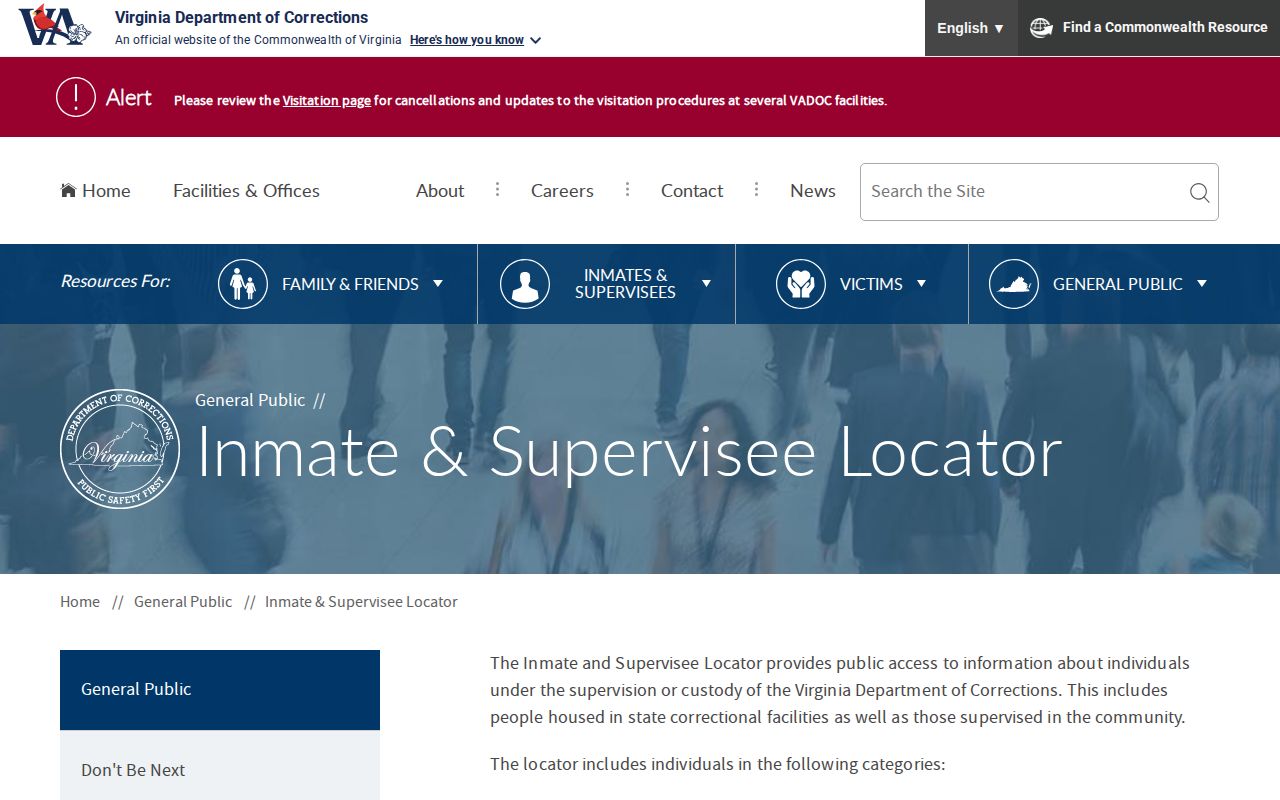
The live result must be read using VADOC's own status and date labels, followed by same-date confirmation when precision matters.
The broader Roanoke County released inmate search is the right route once the question shifts from a future estimate to whether a booking actually ended.
Roanoke County Earned Sentence Credits
VADOC groups older parole-eligible Good Conduct Allowance sentences around felony offenses committed before January 1, 1995 and misdemeanor offenses committed before July 1, 2008. For qualifying active and parole-eligible combinations over twelve months, VADOC can calculate discretionary-parole eligibility, mandatory-parole release, and good-time release. The allowance can range from zero to thirty days per thirty days served depending on the class.
For covered felony offenses on or after January 1, 1995, Code § 53.1-202.2 defines eligibility, while § 53.1-202.3 sets rates. Listed subsection-A offenses are capped at 4.5 credits per thirty days served. Other eligible subsection-B sentences use four levels: fifteen days per thirty at Level I, 7.5 at Level II, 3.5 at Level III, and zero at Level IV. One credit removes one day.
The official earned-sentence-credit statute displays the actual rates and covered structure.
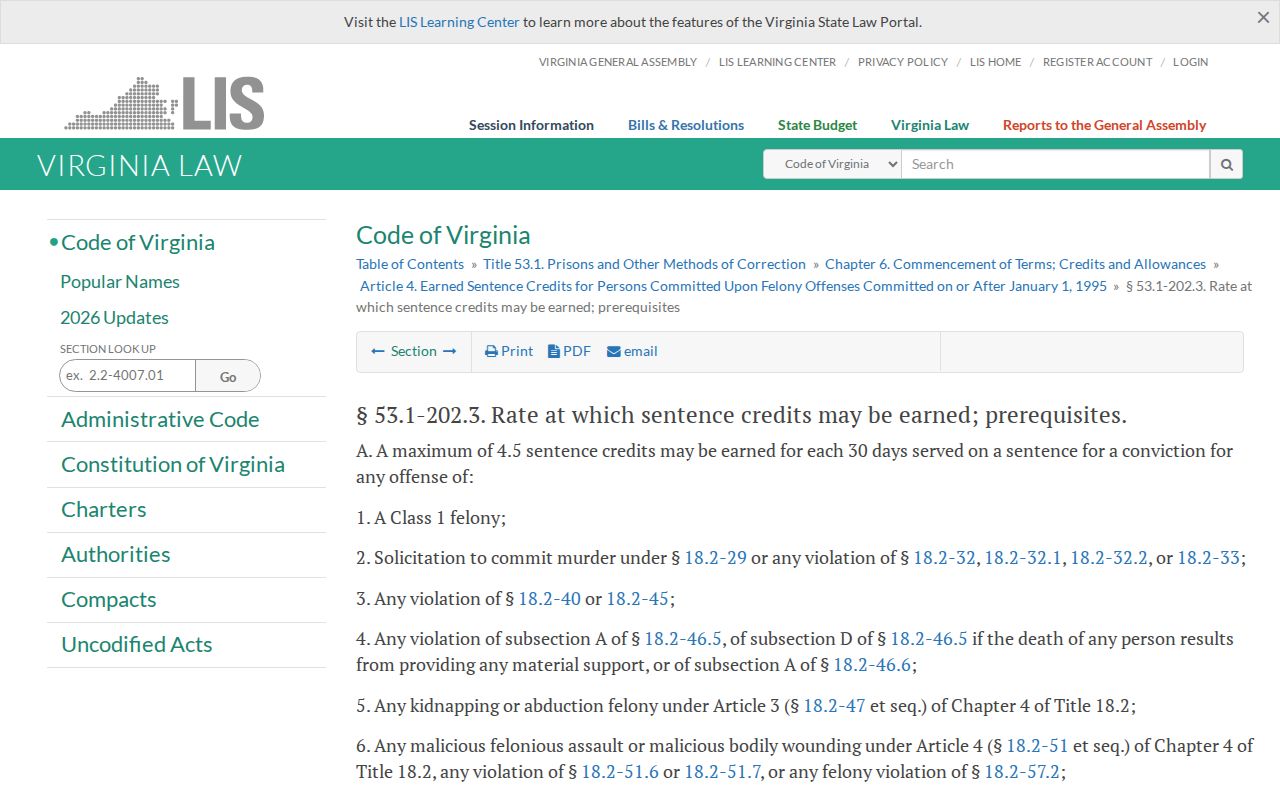
The rates are legal inputs, not a stand-alone release calculator. The offense, statutory version, classification, discipline, mandatory minimums, and other sentences still control.
VADOC uses “serve at least 85%” as shorthand for the restricted post-1994 truth-in-sentencing framework. That phrase must not be multiplied against a sentence to promise a date. Some listed offenses use the 4.5-credit cap, while other eligible sentences can earn more. Jail credit, consecutive terms, class changes, and losses can also alter the calculation.
Local Roanoke County Jail Credits
Local-jail credits have their own Virginia rule. Under Code § 53.1-116, a person sentenced to twelve months or less for a misdemeanor or a combination of misdemeanors generally earns one good-conduct day for each compliant day served unless a mandatory minimum applies. The statute also addresses parole-eligible prisoners and permits added work, class, or local-work-force credits under written policy when available.
That rule does not prove the date on a particular Roanoke County booking. The jail must apply its written policy to the sentence and custody history. Felony credits remain subject to the applicable Article 4 limits for covered post-1994 offenses. Credit for time already confined is governed by Code § 53.1-187, and the court's sentencing order is an essential input.
When the County inquiry's Scheduled Release Date is blank or disputed, request the current computation and written credit policy from Inmate Records. Identify the booking number, sentence, and court case. Ask which authority computed the date and what existing record reflects jail credit. Do not ask staff to create a new legal analysis.
The VADOC Time Computation page explains the authority split and the factors used for state calculations.
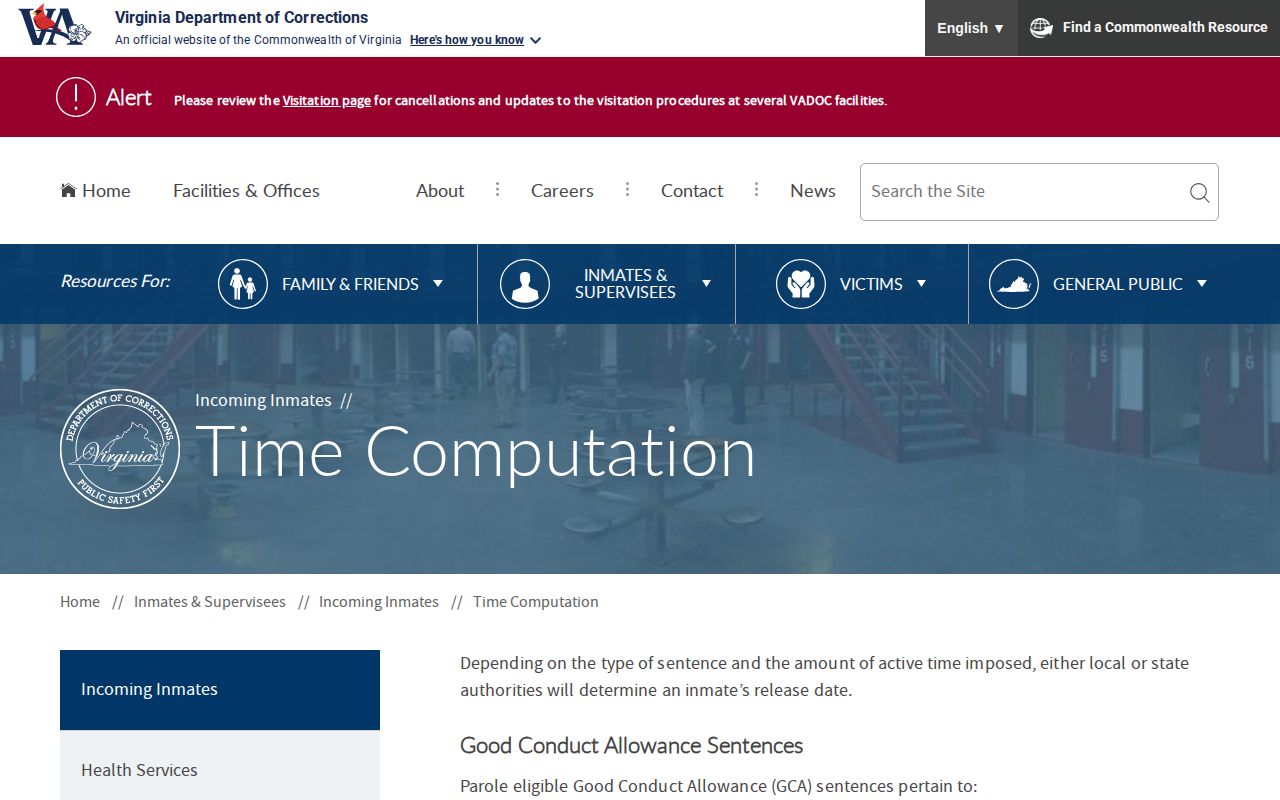
The state guidance helps identify variables, but a County/Salem Jail sentence must still be confirmed with the local authority when it owns the calculation.
Note: Virginia credit rates vary by sentence and law, so no single good-time percentage answers every Roanoke County case.
Why Roanoke Release Dates Change
A projected date changes when an input changes. VADOC names pre-reception jail credit, sentence type, the total imposed sentence, earning class, disciplinary offenses, and other case events. Local computations can also change after a court correction or a new credit entry. The date should always be paired with the day it was observed.
| Factor | Possible effect | Best check |
|---|---|---|
| Jail credit | Qualifying prior confinement can reduce remaining active time. | Sentencing order, credit record, and computing authority |
| Credit class or conduct | Earnings can rise, fall, or be lost under the governing rule. | VADOC or jail computation record |
| Court correction | An amended order can alter the sentence input. | Correct court and latest signed order |
| Consecutive sentence | Another term can extend the practical custody period. | Complete sentence and case history |
| Detainer or hold | One term may end while another agency takes custody. | Release disposition and receiving agency |
| Parole action | A decision can affect an eligible case but may precede physical release. | Board action plus VADOC release record |
| Transfer | The current facility changes while custody continues. | Transfer record and receiving-system search |
A pending charge or warrant may not change the sentence-end calculation yet can change what happens at the gate. ICE, USMS, another jail, or VADOC may receive the person. Thus, “release from the County/Salem Jail” can be true while “return to the community” is false. Always request the recorded disposition or destination when a hold is plausible.
Parole also requires precise language. A Virginia Parole Board Grant does not prove that the person has left the institution. Time computation, release planning, conditions, and detainers may remain. The actual state release is better confirmed through VADOC paperwork and notification, while active parole supervision may appear as a district-office result.
Confirm Roanoke County Release Dates
Confirmation should occur close to the expected event. For a local booking, compare the Scheduled Release Date with the jail docket, the latest court order, and any hold or transfer entry. After processing, open the booking detail and look for the actual Release Date. For WVRJ, call the regional jail because its public lookup is current-only and absence does not prove release.
For VADOC, save the exact locator wording and contact Time Computation or the responsible facility. VADOC facility-release guidance says a discharge or parole release occurs by 11:59 p.m. on the date, weather permitting. That rule belongs only to VADOC facility releases and must not be applied to Roanoke County/Salem Jail or WVRJ. VADOC release papers may include an Order of Release, Conditions of Probation, or Conditions of Parole.
Virginia Jail VINE can supply a contemporaneous local custody alert, while NAAVI handles eligible post-sentence state notifications. Their registrations are separate, and neither is a durable substitute for the release record. The resolved Roanoke County VINELink Inmate Search explains the handoff and alert limits.
If two official sources conflict, preserve both observations and contact the owner of the disputed input. For a wrong jail field, begin with Roanoke County Inmate Records. For VADOC computation, use the Court and Legal Section. For a court error, contact the clerk that entered the order. Report the conflict without choosing a date by guesswork.