
VADOC Release and Supervision Paths
A person sentenced in Roanoke County can become state-responsible and be housed anywhere in Virginia. The VADOC record follows that person, not the county. A state prison term may end through discharge or parole. Discharge means the sentence or controlling custody term has ended as documented by VADOC. Parole is conditional community release for an eligible case, with field supervision through Community Corrections.
The VADOC Facility Release process can produce an Order of Release, Conditions of Probation, or Conditions of Parole. The person and a staff witness sign and date applicable papers. A locator result under a district office can therefore be affirmative evidence that prison custody ended into supervision. It does not mean the person is still inside Roanoke County jail. Full discharge may eventually remove the person from the locator's current custody or supervision coverage.
Search VADOC Release Status
The VADOC Inmate & Supervisee Locator covers institutions, probationers, parolees, institutional hospitals, some local and regional jail placements under VADOC authority, and CCAP. Search with the seven-digit DOC ID whenever available. Otherwise provide at least the first three letters of the first name and the full last name.
- Enter the DOC ID, or use the required name fields.
- Narrow by location, race, gender, or age range only when needed.
- Accept the locator disclaimer and open the matching record.
- Read the custody or supervision category before interpreting any date.
- Note the location or district and the date the system was checked.
- Confirm a same-day change with VADOC, the institution, or the district office.
VADOC says the locator updates daily and may still be inaccurate or outdated. Exact live labels matter. Do not rename a displayed date as “projected release” unless that is what the current record says. The statewide locator is not a substitute for the County/Salem historical inquiry after a short local jail stay. The Roanoke County release search separates those two routes.
The official interface and its daily-update warning appear below.
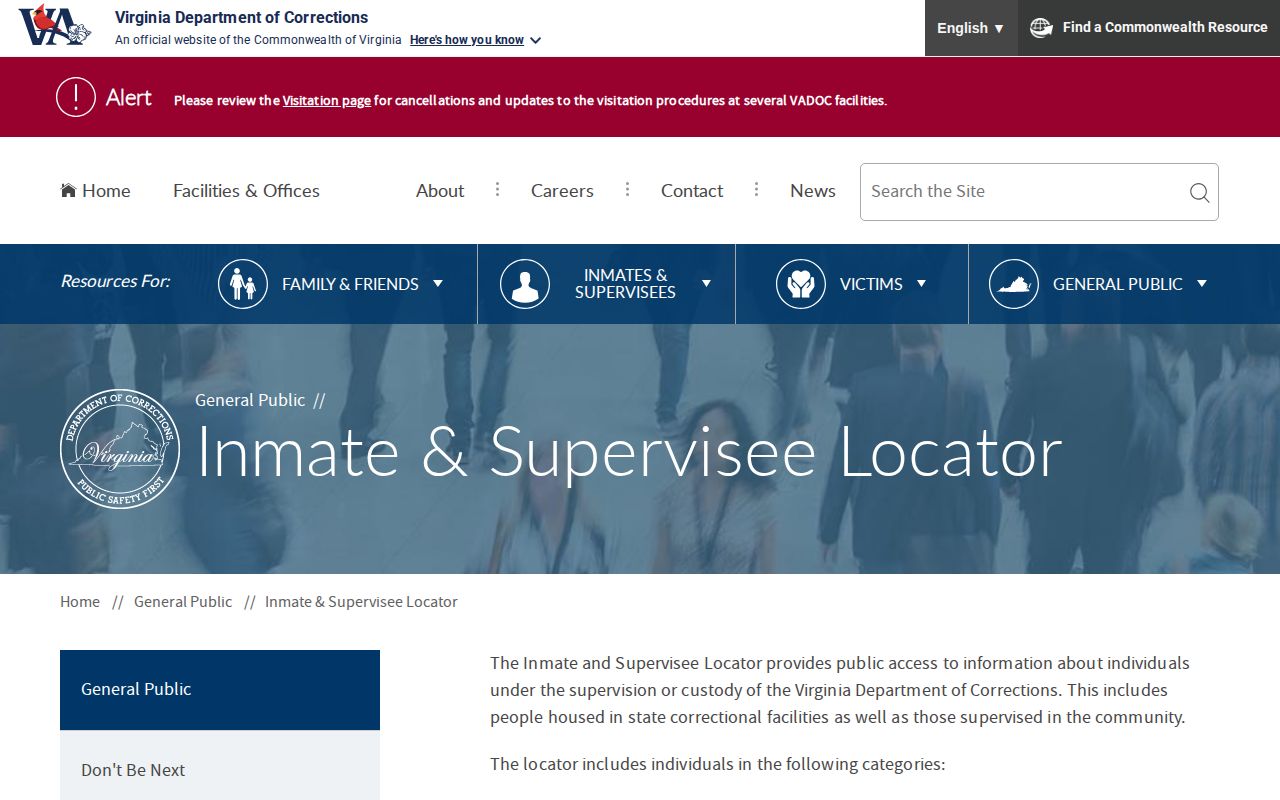
The notice is a reminder to confirm any recent movement with the agency responsible for the displayed location.
VADOC Release Record Evidence
A precise state release claim should rest on the signed release paperwork or the agency's dated custody entry. The court's sentencing order supplies legal inputs, while VADOC calculates state-responsible time. A parole-board grant is not proof that the physical release has occurred. Planning, detainers, sentence calculations, and conditions can still affect the handoff.
| Evidence | What it answers |
|---|---|
| Locator institution | Current reported VADOC custody or placement. |
| Locator district office | Current reported community supervision. |
| Order of Release | The dated VADOC authorization and release document. |
| Parole or probation conditions | Terms that govern community supervision. |
| Time-computation record | The sentence inputs and calculated date. |
| Court order | The sentence, credit, or later judicial change. |
Keep discharge, parole, and probation distinct. Probation is court-ordered supervision and may follow suspended time without a prison parole decision. Parole is conditional release for an eligible sentence. A transfer from County/Salem Jail or WVRJ to VADOC is continued custody, not a community release. The release record must identify which event actually occurred.
VADOC Records and Contact
Questions about state custody or computation go to VADOC. The Correspondence Unit and Court & Legal Section handle time-computation correspondence. Include the full name, seven-digit DOC ID, sentencing court, and the exact field or date in dispute. Do not ask staff to estimate a date from partial facts.
P.O. Box 26963
Richmond, VA 23261
804-674-3000
docmail@vadoc.virginia.gov
Time computation correspondence
Correspondence Unit/Court & Legal Section
6900 Atmore Drive
Richmond, VA 23261
VADOC Operating Procedure 010.3 directs designated staff responding to an inquiry to confirm the projected release date at that time. Privacy and identity rules can still limit what another person receives. For archived proof, request existing release papers, computation materials, or a releasable custody history rather than asking VADOC to create a new narrative.
Note: Date-stamp each locator observation because sentence credits, orders, discipline, jail credit, and detainers can change the reported result.
VADOC Time Computation Limits
VADOC says the responsible authority depends on sentence type and active time. Local authorities calculate many local sentences; VADOC calculates qualifying state-responsible terms. Inputs include pre-reception jail credit, sentence type, total imposed sentence, credit-earning class, disciplinary offenses, and other case events. Multiple sentences, mandatory minimums, later court corrections, and holds can change the practical release date.
Virginia's earned-sentence-credit rules vary by offense and statutory category. Section 53.1-202.3 limits listed offenses to a maximum of 4.5 credits per 30 days served. Other eligible sentences use four levels ranging from 15 credits per 30 days at Level I to zero at Level IV. One credit deducts one day. These rules cannot be applied as a simple public calculator without the exact sentence and eligibility data.
The VADOC Time Computation page explains the factors and correction route. A date in a public result is a snapshot. Confirm the exact label and current value with the responsible authority before planning around it.
- Projected date
- A calculated future date that can move.
- Actual release
- The completed custody event recorded by VADOC.
- Discharge
- The documented end of the controlling correctional term.
- Parole
- Conditional community release under supervision for an eligible case.
VADOC Release-Day Documents
VADOC's Facility Release guidance says discharge or parole release occurs by 11:59 p.m. on the assigned date, weather permitting. That rule applies to VADOC facility releases. It must not be imported into the County/Salem Jail or WVRJ, where no official local time-of-day rule was found.
Release-day documents and conditions provide more durable evidence than a locator screen. An Order of Release identifies the authorized event. Conditions of Parole or Probation identify the supervision track and obligations. A notification-of-release letter may also document the state event. For eligible notifications, VADOC Victim Services and NAAVI are the post-sentence path, separate from local Jail VINE.
The official process is illustrated in the captured agency page.
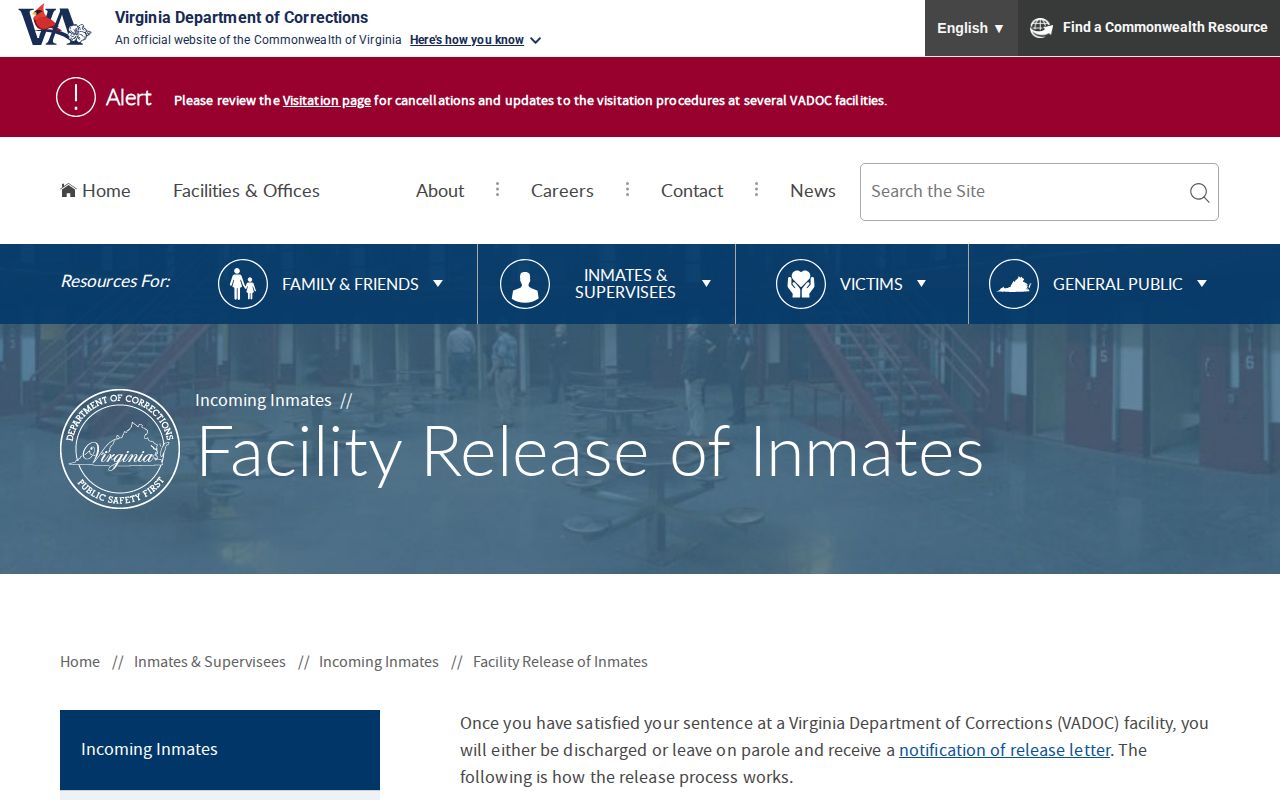
The process page links the release date to signed papers and clarifies why the state event needs VADOC confirmation.
Roanoke VADOC Release Follow-Up
District 15 Community Corrections serves the Cities of Roanoke and Salem, Roanoke County, and the Town of Vinton. If the locator places a released person under that district, the office is the local verification route for reporting location and supervision questions. Staff may not disclose private case details, and district information does not supply the county jail's exact release reason or time.
No VADOC prison was identified within Roanoke County. A state-responsible person may pass through County/Salem Jail or WVRJ, then move to an institution elsewhere. At each step, use the custodian responsible for that period. The County booking shows the local episode. WVRJ records show the regional commitment. VADOC papers document the state release. Court records explain the sentence and later orders.
If a VADOC match disappears after full discharge, obtain the release document or court record. Absence cannot prove the release date, erase the underlying case, or establish that no other custody remains. BOP, ICE, and USMS are separate systems and must be checked only when the case facts point there.
VADOC Transfer History Matters
WVRJ opened in 2009 for four member localities and also holds state-responsible prisoners. That local history explains why a Roanoke County person can appear at a regional jail while already under state authority. A later move into a VADOC institution is a transfer within the wider correctional path, not a fresh community release.
Build the timeline from dated records: local booking, regional commitment if any, VADOC reception, computation updates, release authorization, physical release, and community supervision. Use identifiers at each point. Names alone can merge different people, while an old released episode can coexist with a later active one.
Note: The strongest state-release account names the source, exact record label, observation date, and any unresolved receiving-custodian question.
VADOC Notification After Release
Virginia uses a separate post-sentence notification path for people in VADOC authority. NAAVI and VADOC Victim Services can provide eligible event notices that may include transfer, advance release, actual release, parole activity, escape or recapture, and return to custody. Local Jail VINE registration does not automatically transfer into this state track. A person following a Roanoke County case must enroll in the service tied to the current custodian.
Notifications help document when an agency reported an event, but they do not replace signed release papers or a time-computation record. Save the person and agency identifier, event wording, and delivery date, then compare the notice with the locator and VADOC release documents. If the underlying status is wrong, correction begins with the facility or VADOC unit that supplied the custody data. The notification system depends on that source record and cannot independently rewrite it.