
Roanoke County Parole and Probation
Parole and probation can both place a released Roanoke County person under community supervision, but they begin in different ways. Probation is imposed by a court, often as part of a sentence with time suspended. Parole is a conditional release decision for a person who is legally eligible under Virginia law. The Virginia Parole Board makes parole decisions, while Virginia Department of Corrections Community Corrections staff supervise both probationers and parolees in the field.
The distinction matters when reading a record. A court docket may state a probation term but will not necessarily show where the person reports today. A parole decision can say Grant without proving the date the person physically left a VADOC institution. The VADOC Inmate and Supervisee Locator may show a district-office location after release because the locator covers community supervision as well as custody. That result should be read as supervision, not incarceration.
| Record point | Parole | Probation |
|---|---|---|
| How it begins | Conditional release for a parole-eligible sentence | Court-ordered supervision in a criminal case |
| Decision source | Virginia Parole Board | Sentencing court |
| Field supervision | VADOC Community Corrections | VADOC Community Corrections |
| Useful proof | Board decision, release paperwork, locator, and district confirmation | Court order, locator, and district confirmation |
| End point | Discharge under the applicable authority | Completion or court-ordered termination |
The precise terms come from the signed conditions and court or Board record. Do not infer a condition from the mere fact that a locator result shows District 15.
- Parole
- Conditional release from incarceration for a sentence that remains legally eligible for parole.
- Probation
- Court-ordered oversight in the community, often tied to suspended sentence time.
- Supervision
- Required reporting and compliance while the person lives outside jail or prison.
- Discharge
- The formal end of the supervision obligation, not the same as release from a county jail booking.
Verify Roanoke County Supervision
A sound check uses more than a name. Start with the seven-digit DOC ID when it is known. Otherwise, VADOC requires at least the first three letters of the first name and the full last name, with optional filters for location, race, gender, and age range. Open the likely result and read whether it describes an institution, local or regional jail placement under state authority, CCAP placement, or a probation-and-parole district. Those categories separate confinement from post-release supervision.
- Search the VADOC locator by DOC ID or name and accept its disclaimer.
- Compare identifiers and open the correct person rather than relying on a name alone.
- Read the location and custody or supervision category. A district office indicates community supervision, not jail custody.
- Check the Virginia court case for the probation order, suspended time, later revocation, or correction.
- Use the official VADOC office directory, then ask District 15 to confirm whether it is the responsible office.
- For parole, compare the Board decision with VADOC release paperwork before claiming that release occurred.
VADOC says its locator is updated daily, yet it may still be inaccurate or outdated. Fully discharged people may no longer fall within its current custody and supervision categories. A no-result therefore cannot prove that supervision never existed or that it ended on a particular date. For the county jail event itself, use the Roanoke County released inmate search and release record path, since District 15 does not supply the jail's actual release time or reason.
The official VADOC locator screen and daily-update notice show why the category and observation date should be saved.
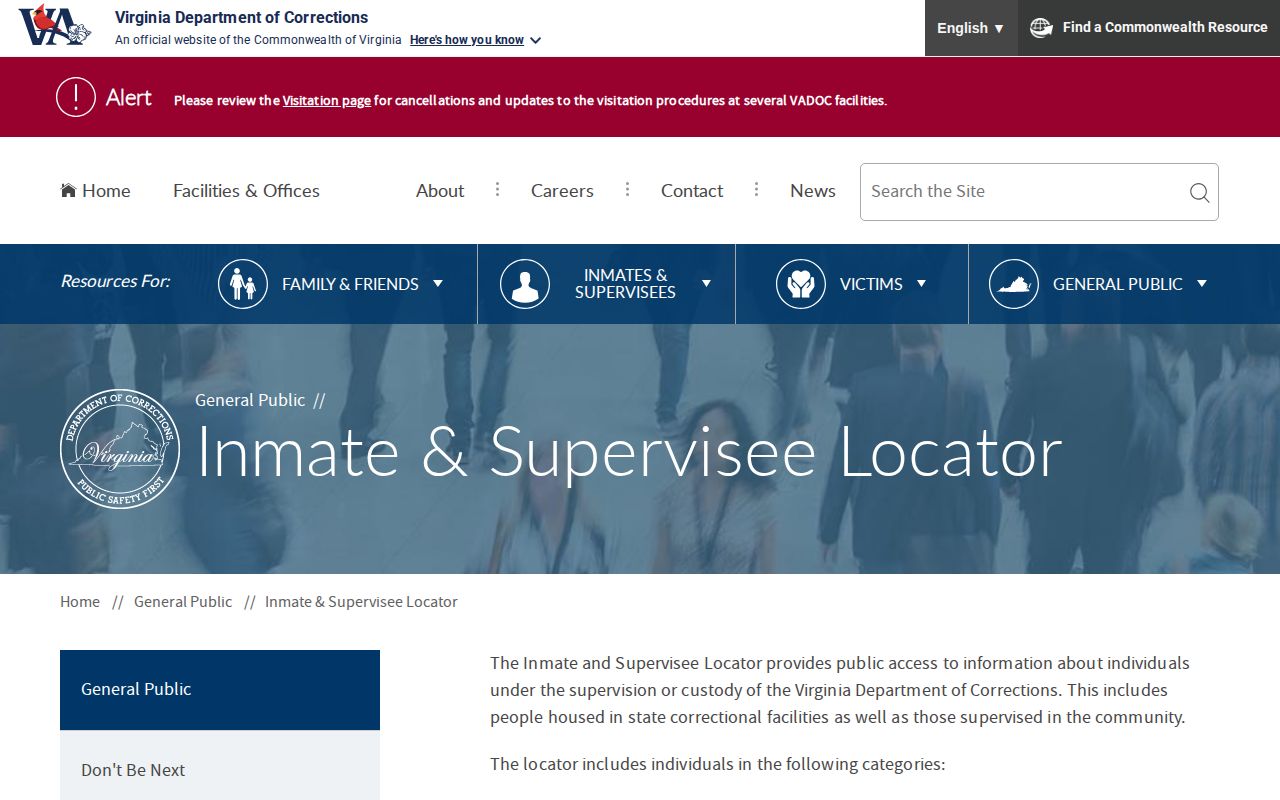
A saved search observation can support later confirmation, but the supervising office and signed record remain stronger evidence when information conflicts.
Note: Record the search date and exact location label because a later transfer, discharge, or correction can change the live result.
District 15 Supervision Details
VADOC Community Corrections District 15 is the local field office named in the Roanoke research. It serves the Cities of Roanoke and Salem, Roanoke County, and the Town of Vinton. That combined service area is important. The office is not limited to the county, and the City of Roanoke should not be confused with Roanoke County when matching a court case or jail booking. Confirm the person's supervising district through the locator before using the office details.
VADOC Community Corrections District 15
305 Electric Road
Salem, VA 24153
540-387-5257
Service area: Roanoke, Salem, Roanoke County, and Vinton
The live VADOC facilities and offices directory should be checked before a visit because office listings and staff assignments can change. District staff may confirm the correct reporting office, but privacy rules can limit what they disclose about an individual case. The signed conditions, court order, and VADOC record are the right sources for a person's duties.
The state-level contact is also useful when District 15 is not the assigned office. VADOC can be reached at 804-674-3000 or docmail@vadoc.virginia.gov, while written time-computation and legal correspondence goes to its Court and Legal Section in Richmond. These channels answer different questions, so a caller should ask whether the issue concerns field supervision, the sentence calculation, or the underlying release paperwork.
Roanoke County Parole Decisions
Virginia's parole framework depends on the offense date and the sentence. Discretionary parole was largely abolished for felony offenses committed on or after January 1, 1995, but statutory exceptions remain. Code § 53.1-151 contains eligibility rules for parole-eligible sentences, including different fractions and limits for later commitments and special provisions for life sentences. The related post-1994 rule also has exceptions. A simple one-quarter formula is therefore not a safe way to predict a Roanoke County release.
The Parole Board public meetings page publishes meeting notices, agendas, live links, and past minutes. Since July 2024, the Board says it meets a person by video when inclined to grant discretionary parole or geriatric conditional release, with an agenda posted before the meeting. That public page is not a complete calendar of every paper review.

The meeting archive helps place a review in context. It does not replace VADOC confirmation of the physical release or District 15 confirmation of active supervision.
Monthly Board reports use results such as Grant, Not Grant, Continue on Parole, and Discharge. A Grant can precede final release planning, time computation, and resolution of detainers. Likewise, Discharge must be read in the report's own case context rather than treated as a Roanoke County jail discharge. Compare the decision date, certification date, DOC number, case type, and jurisdiction with VADOC's record.
Roanoke County Warrants and Absconders
An absconder is a person classified as having failed to maintain required contact with supervision. The label is not a guess based on a missing locator result. It may lead to a warrant or a court capias, which is a court order directing that the person be taken into custody. VADOC's public Most Wanted material is selective, not a full list of every absconder or warrant.
For a Roanoke County probation case, review the correct court docket for a violation filing, capias, hearing, revocation, or later order. General District Court handles misdemeanors and felony preliminary matters, while Circuit Court handles felony dispositions and appeals from lower court. The issuing court or law-enforcement agency is the proper source for a warrant. A lack of a public result cannot support a claim that no warrant exists.
A violation does not itself state the final outcome. A court can continue supervision, modify conditions, revoke suspended time, or enter another order. Parole violations follow Board and VADOC processes. Use the final action and the current custodian's record to distinguish a person still supervised in the community from someone returned to custody.
Note: A selective wanted list and a daily locator are useful leads, but neither is a complete warrant certification service.
Roanoke County Reentry Records
Local release support creates records that may help explain what happened after custody without changing the legal supervision status. The WVRJ 2024 Annual Report describes a named Re-Entry Program, a resource fair, and many requests for birth certificates, Social Security cards, and DMV Connect. Separately, the Roanoke County Jail Division created a behavioral-health and reentry coordinator role in 2023.
Those resources can help a person obtain documents and navigate reintegration, but they do not prove parole, probation, discharge, or a release date. A WVRJ participant may have been held for Roanoke County, another member locality, VADOC, or a contract agency. Match any program record to the correct booking and release event before treating it as evidence about a Roanoke County person.
Community supervision can continue while a person uses reentry services. District 15 remains the verification source for the field-supervision office, while the court order and signed conditions set legal terms. Reentry participation should never be used to infer a violation or to replace direct confirmation from the agency that owns the supervision record.
Roanoke County Release Property Records
Western Virginia Regional Jail documents a distinct property handoff at release. Its Property Officer changes the person out, returns inventoried items, obtains the person's signature, and scans the paperwork into Laserfiche. Donated clothing is available when needed. The signed acknowledgment can corroborate that a WVRJ release process occurred, especially when a current-only roster no longer shows the person.
This property record does not answer every supervision question. WVRJ holds people for several member localities and can also house state-responsible, federal, and contract prisoners. A completed handoff may accompany a community release or a transfer-related process, depending on the actual disposition. Request the release or transfer entry along with the property acknowledgment so that the destination is not assumed.
For a focused WVRJ request, identify the person, approximate custody dates, booking or commitment number if known, and Roanoke County as the committing member. Ask for the existing property-return acknowledgment and the related release or transfer entry. The WVRJ FOIA page lists the authority's request channel.
Note: A property signature can corroborate a handoff, but only the release disposition identifies whether custody ended or shifted elsewhere.
How Roanoke County Supervision Ends
Supervision ends through a formal action, not merely because a name disappears from a public screen. Probation may end when the ordered term is completed or when the sentencing court enters an applicable termination or modification. Parole discharge is documented through the Board and VADOC process. Signed conditions, later orders, and discharge records should be read together when the end date is important.
Virginia public-record law does not make every supervision file open. Under Code § 2.2-3706, imprisonment-related records and adult pretrial, community-probation, and state probation-and-parole records can be discretionary unless another rule applies. Sealed or expunged records have added limits. Ask for a narrow existing record, expect redaction or withholding where authorized, and cite the specific person and case.
Once supervision is discharged, the VADOC locator may no longer show the person as a current supervisee. The court case or agency discharge paperwork can remain the better historical source. If the locator and a signed record conflict, preserve the search date and ask the responsible office to correct or explain the source record rather than choosing the more convenient result.