
Federal BOP Release Scope
The Federal Bureau of Prisons locator covers federal prisoners incarcerated from 1982 to the present. It can retain a former prisoner's record and commonly shows a “Released On” date. That makes it useful for a completed federal prison term, unlike a current-only local roster. The record remains agency-scoped.
A person arrested in the Roanoke area is not automatically a BOP prisoner. Federal pretrial and fugitive custody is usually managed by USMS, often through a contract or local facility. After sentencing, transfer to BOP is continued federal custody. A Roanoke County jail release entry may also show a federal transfer rather than a return to the community.
Search Federal Inmate Releases
Open the BOP Inmate Locator. Search by BOP Register Number when available because it distinguishes same-name records. The form also accepts DCDC, FBI, or INS numbers. A name search can be narrowed by race, age, and sex. Compare all displayed identifiers before reading the status.
- Choose number search when a federal identifier is known.
- Otherwise enter the full name and useful optional filters.
- Open the matching record and copy the register number.
- Read the location and release-date field together.
- Distinguish a past date, future date, Unknown, Deceased, or In Transit.
- Check the federal docket or USMS when BOP does not resolve the event.
A past “Released On” date with no BOP facility strongly supports the end of BOP custody on that date. A future date is projected and can change. “Unknown” means the term is not determined. “Deceased” can appear in the release-date field and must not be described as release. “In Transit” is ambiguous because federal movement can involve USMS.
The official locator form and release field are shown in the captured source.
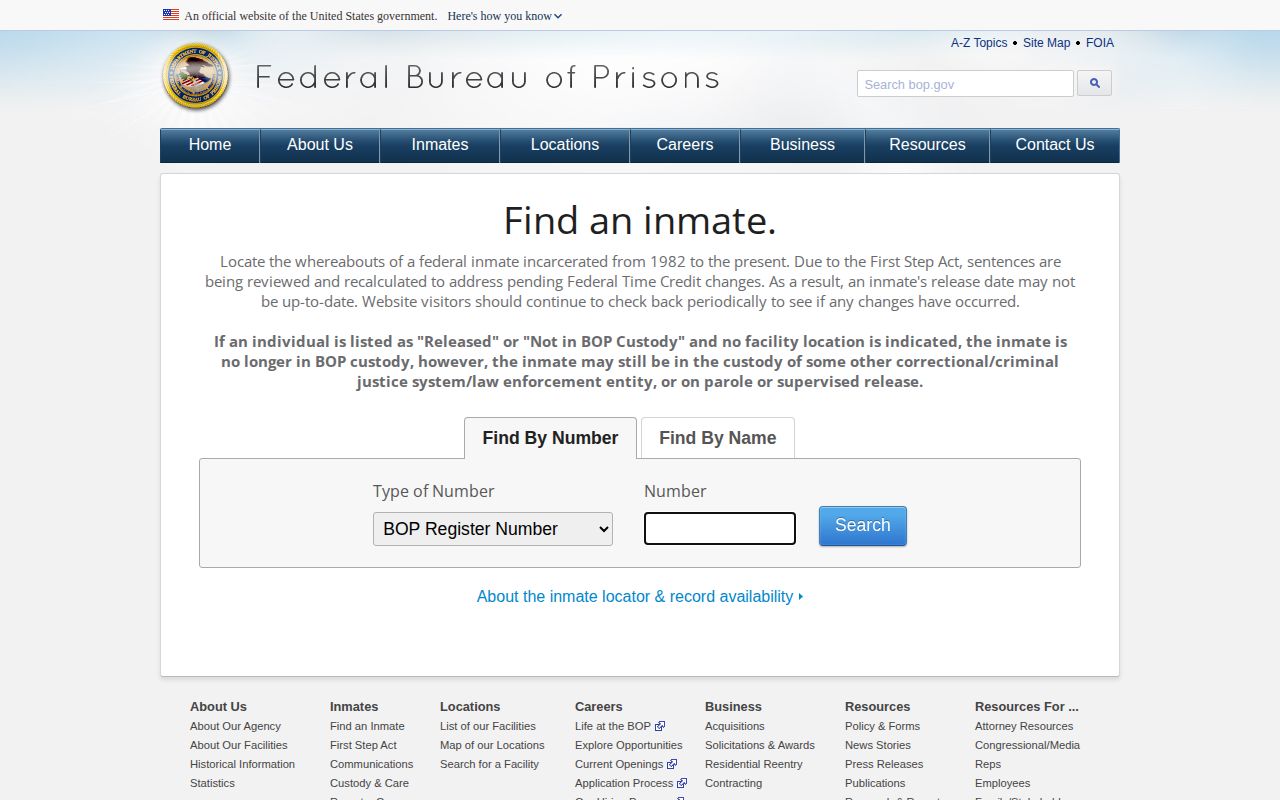
The interface shows why the register number and exact status wording should be saved with the observation date.
Interpret Federal Release Results
BOP warns that another law-enforcement or justice custodian may still hold a person after BOP custody ends. Federal supervised release can also continue in the community under the court's authority. The locator does not certify freedom from every form of custody or supervision.
| BOP display | Careful meaning |
|---|---|
| Past Released On date | BOP reports its custody ended on that date. |
| Future date | A projected BOP date that may change. |
| Not in BOP custody | No present BOP custody; another system may apply. |
| In Transit | Movement is underway or unresolved. |
| Unknown | The federal term or date is not determined. |
| Deceased | A death notation, not a release event. |
First Step Act recalculations can make projected dates stale. Court orders, credits, detainers, and transfers also affect the practical outcome. Never promise a future date based on a single search. For archival proof, use the BOP record with the federal judgment, docket events, and any release or supervision document.
Federal Release Record Channels
The BOP locator is the public first check after a federal sentence. The federal court docket explains the judgment, detention or release orders, sentence, and later supervision events. Counsel can clarify a current court-controlled matter. If the person was never designated to BOP, the holding jail and USMS district are more likely to own the custody movement.
- BOP sentence custody
- Federal prison confinement after designation to the Bureau of Prisons.
- USMS custody
- Federal pretrial, fugitive, and transport authority, often using contract beds.
- Supervised release
- Court-ordered federal community supervision after imprisonment.
- Detainer
- A hold that can send the person to another custodian.
Use the Roanoke County released-inmate search when the first event was a County/Salem or WVRJ booking. An actual local Release Date may mark the federal handoff. Follow the recorded destination rather than describing it as community release.
Note: BOP covers federal prison records, not every person who appears in a federal criminal case.
Federal Custody Contact Route
No single Roanoke County BOP facility contact applies because federal prisoners may be designated nationwide. Use the locator's displayed institution for an active BOP record. For general locator interpretation, use BOP's official locator and FAQ. For pretrial custody, contact the holding facility, counsel, the federal court, or the appropriate USMS district.
Use the BOP Inmate Locator for institution and release status
Search by BOP Register Number or other federal identifier
U.S. Marshals Service records
Office of General Counsel, FOIA Unit
CG-3, 15th Floor
Washington, DC 20530-0001
Requests may also be filed through FOIA.gov
Federal privacy and law-enforcement rules may restrict another person's records. A request should identify existing documents by name, register or prisoner number, approximate date, court, holding facility, and the custody event sought. Broad questions are less useful than a request for a specific transfer, release, or detention record.
Roanoke Federal Transfer Checks
WVRJ can house federal prisoners. Its public JailTracker route is current-only , so a result that disappears could reflect release, USMS movement, BOP designation, ICE custody, or a data change. WVRJ's release or transfer record and the federal docket are the best bridge between systems.
County/Salem Jail is separate. Its historical inquiry can show an actual Release Date for one local booking, but that date alone cannot prove return to the community. If the disposition says federal hold or transfer, search the federal case and ask the receiving custodian. The City of Roanoke jail should not be substituted for a Roanoke County record.
- Confirm the exact local or regional booking.
- Obtain the release disposition or transfer destination.
- Search the federal docket by correct court and case.
- Check BOP only after a federal sentence or designation is plausible.
- Use USMS and the holding jail for pretrial movement.
- Check ICE separately if an immigration handoff is recorded.
This chain avoids a common database error: treating the absence of a BOP match as proof that no federal custody exists.
Federal Release Proof Standards
The strongest evidence is the custodian's dated release or transfer entry. A past BOP release field is strong evidence for the BOP event. A federal court order can authorize release or establish the sentence but may not show the exact time of physical handoff. A current-roster absence or search-engine snippet is only a lead.
Record the access date, full status label, register number, and source. Compare the federal identifier with the court case and any local booking number. If dates conflict, preserve both and ask the agency that owns each field. Do not silently replace an older projected date with a later actual date without documenting which source changed.
A completed BOP term also does not establish that no supervised release, state warrant, ICE hold, or separate case remains. State only what the source proves. That disciplined scope is the difference between a useful federal release record and an unsupported conclusion.
WVRJ History and Federal Holds
WVRJ opened in 2009 as a four-member regional facility after crowding in older local jails. Its operations material confirms that federal and contract prisoners can be housed alongside local and state-responsible people. The mixed population makes the regional release disposition especially important for a federal search.
A move from WVRJ to USMS or BOP can close the regional commitment while federal custody continues. Conversely, a BOP “Released On” date does not describe an earlier WVRJ movement. Build each period from the system that owned it, then connect the periods with transfer entries and court records.
Note: No public USMS historical inmate locator exists, so the federal docket, counsel, holding jail, and targeted records request are the necessary fallback.
Federal Court Release Confirmation
The federal docket is the essential companion to a BOP result. It can show the judgment, detention decision, sentence, later modification, and supervised-release terms. Those entries explain legal authority but should be paired with the custodian's dated record when the question is when physical custody ended. A docket order may precede processing, transport, or resolution of another hold.
When a Roanoke-area federal case began in WVRJ or another holding jail, compare the court case number with the commitment record and BOP register number. The identifiers create a traceable chain that a name search alone cannot supply. If BOP shows a past release while the docket shows supervision, describe both facts: BOP confinement ended, while court-ordered supervision continued. If the docket and locator dates differ, preserve the exact labels and ask the agency that created each entry rather than forcing them into a single event.
BOP Release Date Corrections
If a projected BOP date changes, preserve the older observation and replace it with the current label only after checking the official locator. First Step Act recalculations can affect a projected date, while a past “Released On” value describes the end of BOP custody. The federal judgment and later docket orders help explain the legal basis, but BOP remains the source for its custody field. A correction should state which date was projected, which date was later reported as actual, and when each source was accessed.